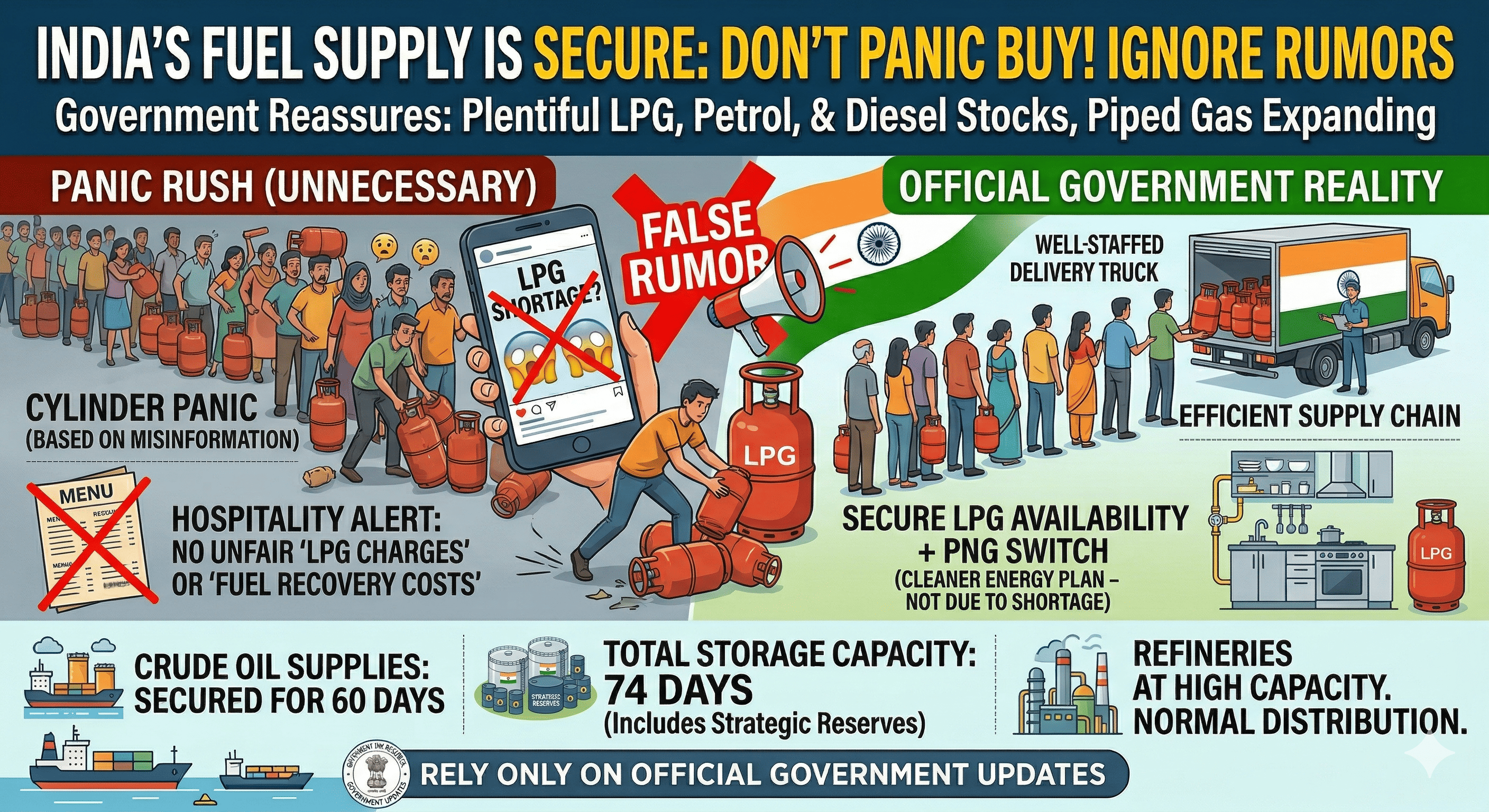
India’s government has clearly stated that there is no shortage of LPG, petrol, or diesel anywhere in the country. This clarification comes after rumours on social media created panic among some people, leading to long queues at fuel stations in a few areas.
According to the Ministry of Petroleum and Natural Gas, India has already secured enough crude oil supplies for the next 60 days. Officials said that oil companies have planned their imports in advance, ensuring that there will be no disruption in fuel availability even if global conditions change.
The government also confirmed that all refineries in India are operating at full capacity. This means petrol, diesel, and LPG are being produced and supplied continuously across the country. Fuel stations, LPG delivery services, and distribution networks are working normally, and there is no need for concern.
Authorities highlighted that the recent panic buying was unnecessary and based on misinformation. Many people reacted to unverified posts and videos online, which suggested a possible shortage. However, officials stressed that such claims are false and urged citizens to trust only official updates.
India has strengthened its energy security in recent years by diversifying its oil imports. The country now sources crude oil from more than 40 different countries, reducing dependence on any single region. This strategy has helped India remain stable even during global disruptions.
One major concern globally has been the situation around the Strait of Hormuz, a key route for oil shipments. Despite tensions in that region, India has managed to maintain steady supply by increasing imports from alternative sources. This has reduced the risk of shortages.
Officials also shared that India’s fuel storage capacity is strong. The country currently holds enough fuel reserves for about 60 days, while total storage capacity goes up to nearly 74 days. These reserves include crude oil, refined petroleum products, and strategic storage facilities.
At the same time, the government is promoting the use of Piped Natural Gas (PNG) in households where pipeline connections are available. Officials clarified that this move is not related to any shortage of LPG. Instead, it is part of a long-term plan to provide cleaner, safer, and more convenient fuel options.
PNG is supplied directly to homes through pipelines, removing the need for LPG cylinders. It is also considered more environmentally friendly and cost-effective in the long run. As infrastructure improves, more cities are being connected to PNG networks.
In another important step, the Central Consumer Protection Authority has directed hotels and restaurants not to charge extra fees such as “LPG charges” or “fuel cost recovery” from customers. The authority said such charges are unfair and strict action will be taken against businesses that violate these rules.
The government has strongly warned against spreading false information about fuel shortages. Officials said that rumours can create unnecessary panic and disrupt normal life. They advised citizens to rely only on trusted and verified sources for updates.
Overall, India’s fuel situation remains stable and well-managed. With strong refinery operations, diversified imports, and sufficient reserves, the country is well prepared to handle any global challenges.
The focus now is not just on maintaining supply but also on building a more sustainable energy system. The promotion of PNG and improvements in infrastructure show that India is planning for the future while ensuring that present needs are fully met.